The Enterprise AI Platform for Mineral Processing
Circuito AI provides a complete environment for building, deploying, and managing AI-driven optimization solutions — from visual model development to real-time process control — all integrated with your existing plant infrastructure.
Visual AI Development Environment
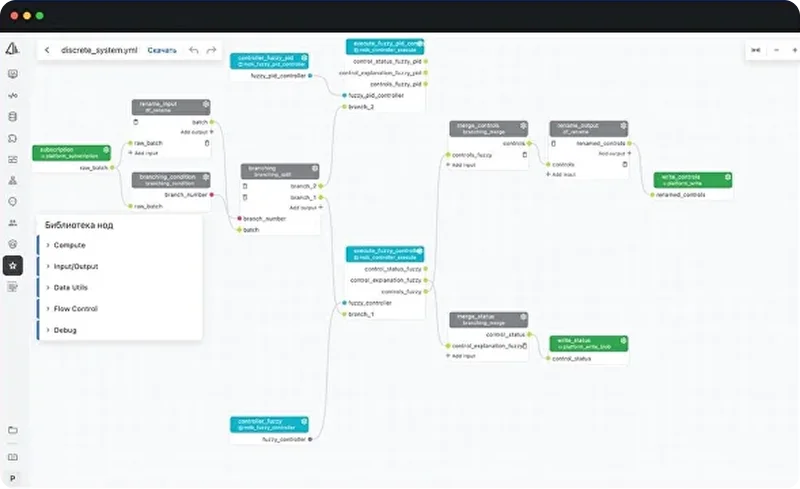
The platform features a graphical workflow editor where engineers build optimization models by connecting functional blocks — data inputs, branching logic, fuzzy controllers, and output actions — without writing code. Models are trained, tested, and deployed from the same interface, reducing development cycles from months to weeks.
Core Capabilities
A complete environment designed for industrial AI
Industrial Data Processing
Connect to plant historians, SCADA systems, and sensor networks. Ingest, validate, and transform real-time operational data for AI model training and inference.
AI Applications
Deploy pre-built and custom AI applications for process optimization, predictive analytics, and automated control across your mineral processing circuits.
ML Model Tools
Build, train, and evaluate machine learning models using the visual editor. Support for regression, classification, reinforcement learning, and custom Python algorithms.
Specialized Instruments
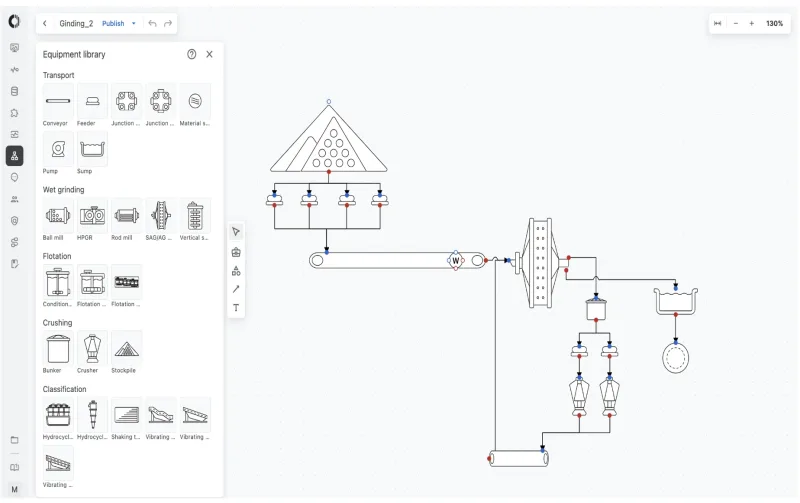
Purpose-built tools for mineral processing: flotation cell vision analysis, mill load estimation, particle size prediction, and reagent dosing optimization.
Visualization & Reporting
Configurable dashboards with real-time charts, KPI tracking, and performance reports. Role-based views for operators, engineers, and management.
Security & Administration
Role-based access control, audit logging, and user management. All data processing runs on-premise with no cloud dependency for operational control.
5-Layer AI Architecture
A layered approach to robust, reliable industrial AI control
Predictive AI Models
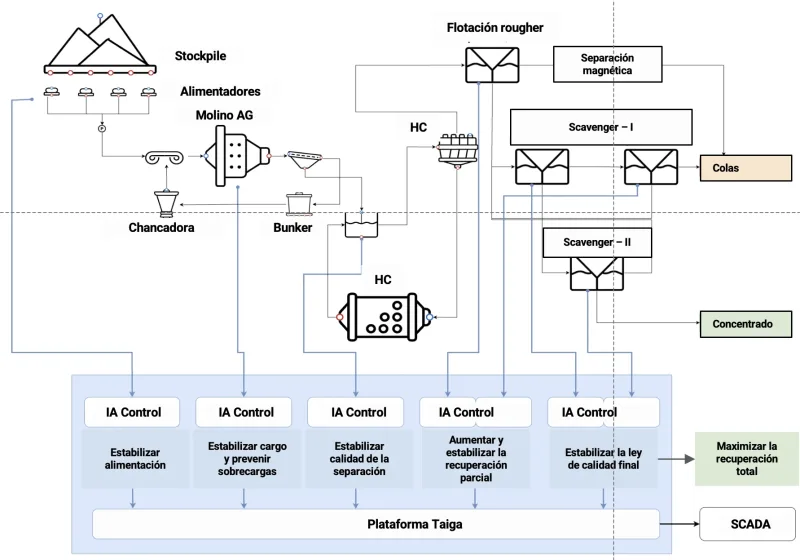
Machine learning models trained on historical and real-time process data learn the dynamics of your specific operation — anticipating disturbances and optimizing setpoints before deviations occur.
Multi-Criteria MPC Controllers
Model Predictive Control (MPC) manages multiple process objectives simultaneously — balancing throughput, recovery, energy consumption, and equipment protection in a single optimization loop.
Regular Retraining
Models automatically retrain on fresh operational data to adapt to changing conditions — ore blend variations, liner wear, seasonal shifts — without manual intervention from your engineering team.
Expert Rules & Fuzzy Logic
Process engineer expertise encoded as rule-based systems prevents illogical AI decisions and manages emergency scenarios — ensuring the system respects physical constraints, not just statistical patterns.
Autonomous Algorithms
Algorithms designed to stabilize and control the process even with scarce or low-quality sensor data — a critical capability for operations where instrumentation may be less mature.
Solution Constructor
The low-code Solution Constructor lets process engineers build AI optimization models through a visual drag-and-drop interface. Connect data sources, processing blocks, branching conditions, and control outputs into complete automation workflows — with a built-in library of compute, I/O, data utility, flow control, and debug components.
- Visual node-based editor — your process engineers can build models directly, no data science team required
- Built-in component library: compute, I/O, data utilities, flow control, and debug blocks
- Models auto-retrain on fresh operational data to adapt to changing conditions
Real-Time Dashboards
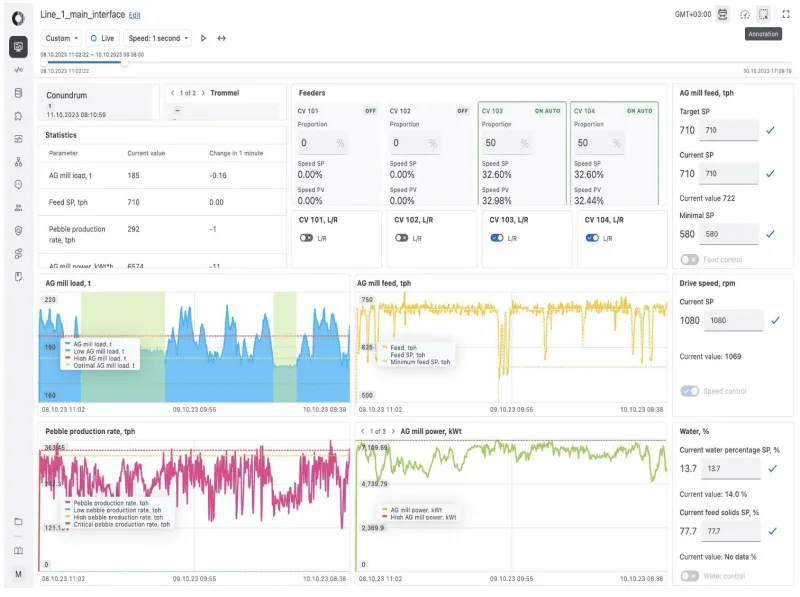
Configurable monitoring interfaces that display live process data, AI model outputs, and performance metrics from your existing plant infrastructure. Each dashboard is tailored to the user's role — operators see control recommendations, engineers see model performance, and management sees production KPIs.
- Role-based views for operators, process engineers, and plant management
- Live data exchange with existing SCADA, DCS, and historian systems
- Historical trend analysis and performance comparison reports
Data Processing & Diagnostics
A comprehensive data management layer that handles industrial data ingestion, validation, labeling, and transformation. Automated diagnostics detect sensor drift, data gaps, and anomalies — ensuring AI models always train and operate on clean, reliable process data.
- Automated sensor diagnostics detect drift, gaps, and anomalies in real time
- Data validation and transformation pipelines ensure model input quality
- Supports integration with OPC-UA, Modbus, plant historians, and custom APIs
See the Platform in Action
Watch how Circuito AI's real-time dashboards and diagnostic tools work together to monitor, analyze, and optimize mineral processing operations.
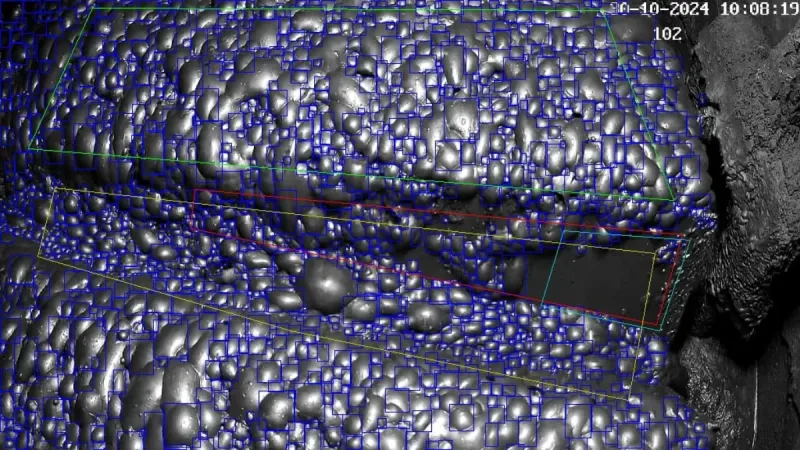
Computer Vision — Froth Sensor
A proprietary computer vision system that analyzes flotation froth in real time. Cameras mounted above flotation cells capture continuous video, and AI algorithms extract key froth characteristics — enabling closed-loop optimization without manual visual inspection.
- Monitors bubble size distribution, froth speed, and froth stability in real time
- Integrates directly with AI optimization models for fully autonomous flotation control
- Automatically corrects cell settling and froth layer to maximize recovery
Architecture & Deployment
Enterprise-grade infrastructure designed for industrial environments
On-Premise Installation
Fully installed at your site by the Circuito AI technical team. All data stays within your network — no cloud dependency for operational control.
Data Sovereignty
Your process data never leaves your site. Remote access is strictly regulated and used only for monitoring and support with your explicit authorization.
Python SDK
For operations with in-house data teams, the Python SDK provides full API access to platform data and functionality — enabling custom applications and integrations beyond the standard optimization suite.
24/7 Technical Support
Dedicated support team with 3 levels of SLA available around the clock. Software updates and configuration managed by our team — no IT burden on your side.
Frequently Asked Questions
What is the Circuito AI platform?
Circuito AI is an enterprise AI platform purpose-built for mineral processing optimization. It provides a complete environment for building, deploying, and managing AI-driven optimization solutions — from visual model development to real-time process control — all on-premise with full data sovereignty.
How does the 5-layer AI architecture work?
The 5-layer architecture combines predictive AI models, multi-criteria MPC controllers, regular retraining on fresh data, expert rules with fuzzy logic, and autonomous algorithms. This layered approach ensures robust, reliable control even with scarce or low-quality sensor data.
Is the Circuito AI platform deployed on-premise or in the cloud?
Circuito AI is deployed 100% on-premise. All data processing, model training, and process control happens within your plant network. There is no cloud dependency for operational control. Remote access is strictly regulated and used only for monitoring and support with your explicit authorization.
Start With a Free Assessment
We'll analyze your plant data and show you where AI can move the needle — no commitment, no contract. If the numbers make sense, we run a pilot on one circuit before you scale.